
[A recent post from Robert Reich on his Substack, worth reading all the way through.]
How to Communicate with Gen Z?
Friends,
Voter turnout among 18-to-29-year-olds in the 2026 midterm elections was among the highest for midterms since the passage of the 26th Amendment in 1971 (which lowered the voting age from 21 to 18). Youth turnout was particularly high in battleground states.
Thank you, Gen Z.
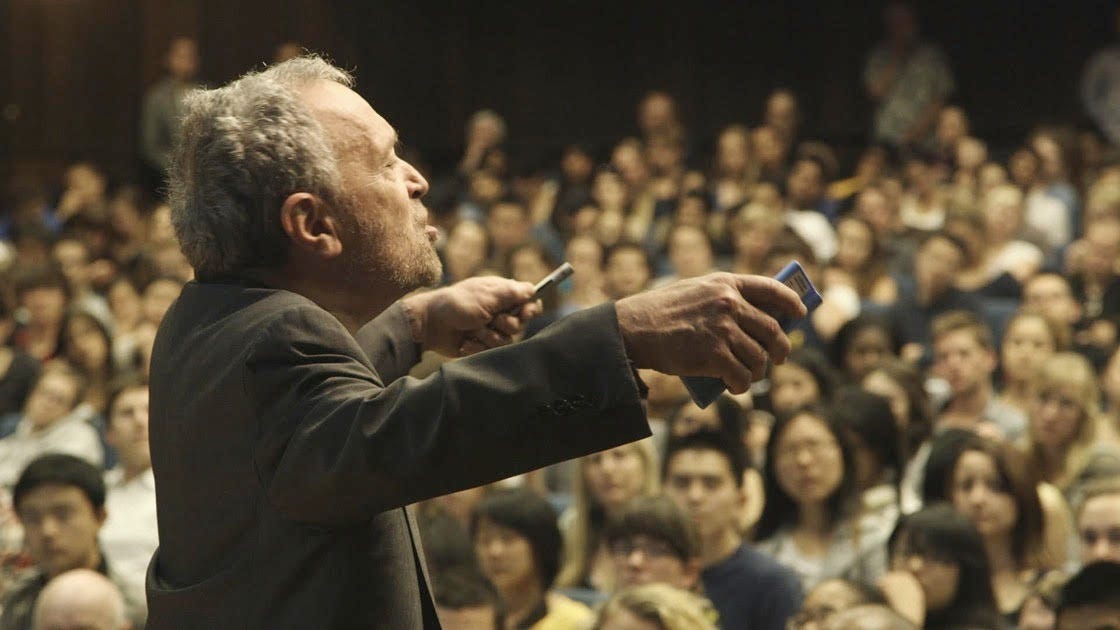
Most of the people I deal with daily — the people I talk with, meet with, collaborate with, teach, Zoom with, make videos with, and have lunch and coffee with — are 50 years younger than I am. Gen Z.
I don’t dwell on the half-century gulf between us, but it occasionally slams me in the face — as when I catch our reflection in the window of a coffee shop and wonder for an instant about the identity of that little old man in our midst.
Or when I make a casual reference to Humphrey Bogart or Archibald Cox and they stare back blankly. Or when I refer to “the Rosemary Woods stretch” or being “Borked” or “swift-boated” and they don’t have the slightest idea what I’m talking about.
Recently some of us got into a conversation about clothing, and I mentioned that I’d stored my tony jacket in my valise above the chest of drawers in the den. I might as well have been talking ancient Greek.
I miss lots of what they say, too. Recently, one of them opined that Texas’s Senator-elect James Talarico had a lot of “rizz.”
“What’s ‘rizz?’” I asked. They laughed. Another told me that the “vibe” of something I’d written was “immaculate.” Another congratulated me for “clapping back at Elon Musk,” prompting a third to say “What a flex!” What language are they speaking?
“A flex?” I asked.
“A flex! A flex!” she said more loudly, as if she were talking to someone hard of hearing.
I am becoming hard of hearing, damnit. But that wasn’t the problem.
A half-century has become a chasm in the landscape of living memory. A person who tries to speak across it risks warping the time-space continuum.
My undergraduate students were born after 9/11. They don’t remember a time when the United States was united over anything. For many, their political consciousness has been shaped by the loathsome Trump. They barely remember when Barack Obama was president.
They have a hard time believing I’ve lived most of my life before the internet. When I tell them I was born even before television, they look at me as if I’m a fossil. I suppose I am.
When I tell my undergraduates that I once advised Obama, they’re somewhat impressed. Labor secretary to Bill Clinton? Their eyes begin to glaze over. Worked for Jimmy Carter? Not particularly interested. Interned for Bobby Kennedy? Campaigned for Eugene McCarthy? They look puzzled, as if I’ve entered the misty expanses of ancient history.
Sometimes I follow this by telling them I started my career as an assistant to Abraham Lincoln. This used to elicit a laugh. I’m beginning to fear it won’t much longer.
The challenge is how to communicate with Gen Z across the half-century divide.
Several years ago, my younger son, Sam, who runs a popular social media platform called Dropout, told me I should spend less time writing books and more making films and videos. We were in the kitchen of my house in Berkeley, drinking coffee, when Sam decided it was time for a heart-to-heart.
“Dad, how many books have you written?” he asked, with the hint of a grin.
“Not sure. Fifteen to 20,” I responded. “Why do you ask?”
I recognized the grin. Since he was a teenager, Sam has enjoyed baiting me.
“You’ve spent a lot of time writing books.”
“Yes. So, what’s your point?”
“You might want to reconsider how you’re spending your time.”
“You think I’ve wasted it?”
“Not exactly wasted,” Sam said. “I mean, some people have bought your books.”
Sam was coming in for the kill. He’d been thinking about this conversation.
The night before, over dinner, I related that I’d recently been at a fundraising event at someone’s house in Oakland where I found a copy of one of my first books on a shelf and told the host how excited I was to see it. The host, looking embarrassed, suggested I pull the book out from its place on the shelf. When I did and opened it, I saw that the entire inside had been hollowed out to create a safe-keeping place for jewelry. My book made such an excellent safe because no one would ever think to pull it off the shelf. Sam laughed, but the story emboldened him to begin our conversation the next morning.
Sam continued: “I mean, the reason you write is to reach people, right?”
“Of course.”
“And as an educator you especially want to reach young people.”
“Sure, because young people are still open to lots of ideas, and if you get into their heads, you might influence them for life.”
Sam’s eyes lit up. “Okay, then. Have you thought about social media?”
He might as well have asked, “Have you thought about a zebra?” I had no idea what he was getting at.
“You mean, the internet?”
“I guarantee you, Dad, that if you put as much time and energy into social media as you put into writing books, you’d reach five times as many young people.”
I was skeptical. I had watched some of Sam’s comedy videos, but I didn’t make the connection, at least not at first. But Sam was patient with me, explaining how it was done, encouraging me to try.
And I did try. I teamed up with a young filmmaker named Jake Kornbluth, and we made a bunch of three-minute videos about politics and the economy. A few went viral. Then we made the feature film Inequality for All, which won an award at the Sundance Film Festival, went into hundreds of movie theaters, and has since found its way into thousands of high school classrooms.
After that, I was fortunate to find several other hugely talented young people, along with Heather Lofthouse, who have helped me make more films and videos.
Sam was wrong about one thing, though. The videos and films didn’t reach five times as many young people as my books. A more accurate ratio would be 50 times as many; maybe 500 times as many.
Turning to social media to communicate with Gen Z made sense because, as I learned, the brains of many young people are wired differently from the brains of old boomers like me. I already sensed this in classrooms where I taught undergraduates. My students were more sensitive to visual cues than verbal cues. They learned more when I jumped into the aisles of the lecture hall and role-played various characters, engaging them in verbal jousting, than when I delivered a lecture. They reacted more to live performances than to words. They were wired for action, sound, speed, movement.
So if I wanted them to understand some of the ideas I’ve written about in my books, I needed ways to convey those ideas that weren’t just words on the pages of a book — ways that challenged several of their senses simultaneously. That meant films. Videos. Short essays on Substack often accompanied by drawings and videos.
I still write books, of course, because I love writing and continue to believe in the power of books to illuminate and explain. But I spend most of my time now doing videos and writing this Substack.
Not only is Sam correct about this being a way to reach young people, but spending most of my time with Gen Z has been a blessing. These young people inspire me. They push me. They make me laugh.
They’re going to inherit the mess my generation has bequeathed them. Instead of being bitter or angry, they have all sorts of ideas for how to clean it up, fix it, make the world better. They have the energy and determination to succeed. They keep me optimistic and sane. They make me hopeful that the common good can be resurrected.
Don’t get me wrong — it’s not all about chronological age. I know some young people who act as rigid and compulsive as the stiffest of my boomer peers, and I know some people who are old chronologically but have the youngest hearts I’ve ever known. But overall, I draw huge amounts of strength and happiness from the young people I deal with every day.
While I am grateful for so many good things in my life, I want to give special thanks to them.
1 comment:
Take solace, the same was said of our generation !
Rex in DC
Post a Comment